Texas A&M Math Learning Center logo

Math 308 Week in Review 3 (Solutions)

Directions: Full worked solutions for Week in Review 3 (Differential Equations). Click Solution under any problem to reveal the worked answer. Use the Contents panel or the Prev / Up / Next buttons to move between sections, and Search to find terms on this page.

Problems

1.

Consider the initial value problem $y' = t^2 \cos y + e^{t}$, $y(0) = 1$. Does the Existence and Uniqueness Theorem guarantee a unique solution exists near $t = 0$?

Here $f(t,y) = t^2 \cos y + e^{t}$. Computing the partial derivative:

\[\dfrac{\partial f}{\partial y} = -t^2 \sin y\]

The function $f$ is built from polynomials, trig functions, and exponentials—all continuous everywhere. Similarly, $f_y = -t^2 \sin y$ is continuous everywhere. Since the initial point $(0, 1)$ lies in a region where both $f$ and $f_y$ are continuous, the hypotheses are satisfied.

\[\boxed{\text{Yes, a unique solution exists near } t = 0}\]
2.

Determine whether the equation $(2ty + 3) + (t^2 + 4y)\,y' = 0$ is exact. If so, find the general solution.

We have $M(t,y) = 2ty + 3$ and $N(t,y) = t^2 + 4y$. Checking exactness:

\[M_y = 2t, \qquad N_t = 2t\]

Since $M_y = N_t$, the equation is exact. Integrating $M$ with respect to $t$:

\[\int M\,dt = \int (2ty + 3)\,dt = t^2 y + 3t + h(y)\]

So we have:

\[F(t,y) = t^2 y + 3t + h(y)\]

To find $h(y)$, use $F_y = N$: $t^2 + h'(y) = t^2 + 4y$, so $h'(y) = 4y$, giving $h(y) = 2y^2$.

\[F(t,y) = t^2 y + 3t + 2y^2\]
\[\boxed{t^2 y + 3t + 2y^2 = C}\]

3.

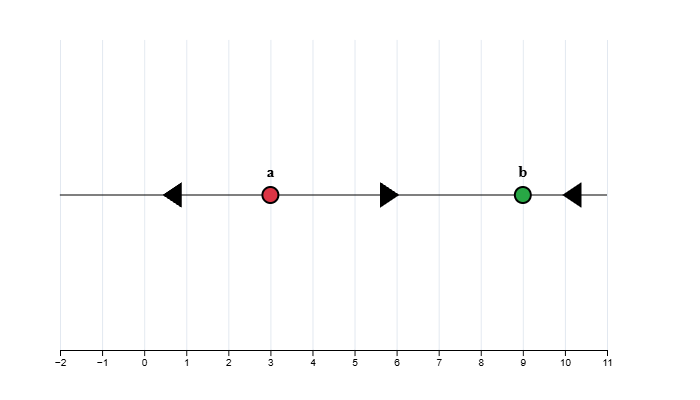
Consider the autonomous equation $y' = 2y(2 - 3y)$. Find all equilibrium solutions, draw the phase line, classify each equilibrium as stable or unstable, and determine $\lim_{t \to \infty} y(t)$ if $y(0) = 0.5$.

(a) Equilibria occur where $y' = 0$:

\[2y(2-3y) = 0 \implies y = 0 \text{ or } y = \dfrac{2}{3}\]

(b) Let $f(y) = 2y(2-3y)$. We test the sign in each region:

For $y < 0$: $f(-1) = 2(-1)(2+3) = -10 < 0$ (←)

For $0 < y < \dfrac{2}{3}$: $f(0.5) = 2(0.5)(2-1.5) = 0.5 > 0$ (→)

For $y > \dfrac{2}{3}$: $f(1) = 2(1)(2-3) = -2 < 0$ (←)

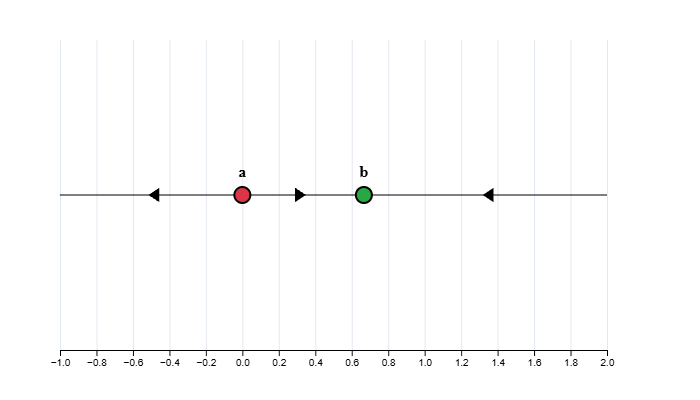
Phase line: arrows point left below 0, right between 0 and 2/3, left above 2/3

(c) At $y = 0$: arrows away → unstable. At $y = \dfrac{2}{3}$: arrows toward → stable.

(d) Starting at $y(0) = 0.5$, arrows point toward $\dfrac{2}{3}$.

\[\boxed{y = 0 \text{ (unstable)}, \; y = \tfrac{2}{3} \text{ (stable)}, \; \lim_{t \to \infty} y(t) = \tfrac{2}{3}}\]

4.

Find the largest interval on which a unique solution is guaranteed to exist for the initial value problem $(t + 1)y' - 2y = t^{2}$, $y(0) = 3$.

Dividing by $(t+1)$ to get standard form:

\[y' - \dfrac{2}{t+1}y = \dfrac{t^2}{t+1}\]

Here $p(t) = \dfrac{-2}{t+1}$ and $g(t) = \dfrac{t^2}{t+1}$. Both have a discontinuity at $t = -1$.

Intervals of continuity: $(-\infty, -1)$ and $(-1, \infty)$. Since $t_0 = 0 \in (-1, \infty)$:

\[\boxed{(-1, \infty)}\]

5.

Solve the initial value problem $(3t^{2}y + \cos t) + (t^{3} - 2y)y' = 0$, $y(0) = 1$.

We have $M = 3t^{2}y + \cos t$ and $N = t^{3} - 2y$. Checking exactness:

\[M_y = 3t^{2}, \qquad N_t = 3t^{2}\]

Since $M_y = N_t$, the equation is exact. Integrating $M$ with respect to $t$:

\[\int M\,dt = \int (3t^{2}y + \cos t)\,dt = t^{3}y + \sin t + h(y)\]
\[F(t,y) = t^{3}y + \sin t + h(y)\]

Using $F_y = N$: $t^{3} + h'(y) = t^{3} - 2y$, so $h'(y) = -2y$, giving $h(y) = -y^2$.

\[F(t,y) = t^{3}y + \sin t - y^2\]

General solution: $t^{3}y + \sin t - y^2 = C$. With $y(0) = 1$: $0 + 0 - 1 = -1$.

\[\boxed{t^{3}y + \sin t - y^2 = -1}\]

6.

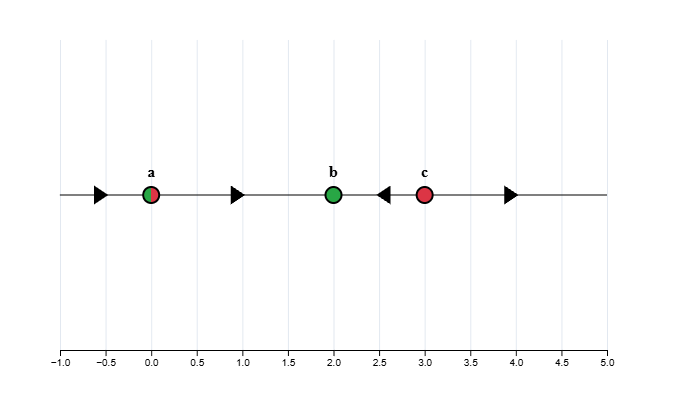
Consider the autonomous equation $y' = y^2(y - 2)(y - 3)$ with initial condition $y(0) = 2.5$. Draw the phase line, classify all equilibria, and find $\lim_{t \to \infty} y(t)$.

(a) Equilibria: $y = 0$ (double root), $y = 2$, $y = 3$.

Testing $f(y) = y^2(y-2)(y-3)$:

For $y < 0$: $f(-1) = (1)(-3)(-4) = 12 > 0$ (→)

For $0 < y < 2$: $f(1) = (1)(-1)(-2) = 2 > 0$ (→)

For $2 < y < 3$: $f(2.5) = (6.25)(0.5)(-0.5) < 0$ (←)

For $y > 3$: $f(4) = (16)(2)(1) = 32 > 0$ (→)

Phase line: arrows right below 0, right between 0-2, left between 2-3, right above 3

(b) $y=0$: semistable. $y=2$: stable. $y=3$: unstable.

(c) Starting at $y(0) = 2.5$ (between 2 and 3), arrows point toward 2.

\[\boxed{y=0 \text{ (semistable)}, \; y=2 \text{ (stable)}, \; y=3 \text{ (unstable)}, \; \lim_{t\to\infty} y(t) = 2}\]

7.

Consider the initial value problem $y' = 3y^{2/3}$, $y(0) = 0$. Verify that $y_1(t) = 0$ is a solution, find another solution $y_2(t)$, and explain why the existence of two solutions does not contradict the Existence and Uniqueness Theorem.

(a) If $y_1 = 0$: $y_1' = 0$ and $3(0)^{2/3} = 0$. Both sides match. ✓

(b) Separating variables:

\[\dfrac{dy}{y^{2/3}} = 3\,dt \implies \int y^{-2/3}\,dy = \int 3\,dt \implies 3y^{1/3} = 3t + C\]

With $y(0) = 0$: $C = 0$. So $y^{1/3} = t$, giving $y_2(t) = t^3$.

(c) Computing the partial derivative:

\[\dfrac{\partial f}{\partial y} = \dfrac{2}{y^{1/3}}\]

At $y = 0$, this is undefined. Since $f_y$ is discontinuous there, the theorem doesn't apply—it makes no guarantee about uniqueness.

\[\boxed{y_1 = 0, \; y_2 = t^3; \; f_y \text{ is discontinuous at } y=0}\]

8.

Verify that the equation $(ye^{ty} + 2t) + (te^{ty} + 3y^{2})y' = 0$ is exact and find the general solution.

We have $M = ye^{ty} + 2t$ and $N = te^{ty} + 3y^{2}$. Using the product rule:

\[M_y = e^{ty} + tye^{ty} = e^{ty}(1 + ty)\]
\[N_t = e^{ty} + tye^{ty} = e^{ty}(1 + ty)\]

Since $M_y = N_t$, the equation is exact. Integrating $N$ with respect to $y$:

\[\int N\,dy = \int (te^{ty} + 3y^{2})\,dy = e^{ty} + y^3 + g(t)\]
\[F(t,y) = e^{ty} + y^3 + g(t)\]

Using $F_t = M$: $ye^{ty} + g'(t) = ye^{ty} + 2t$, so $g'(t) = 2t$, giving $g(t) = t^2$.

\[F(t,y) = e^{ty} + y^3 + t^2\]
\[\boxed{e^{ty} + y^3 + t^2 = C}\]

9.

A population of fish follows the logistic growth model with growth rate $r = 0.18$ per year and carrying capacity $K = 12$ million. A constant harvesting rate of $H$ million fish per year is applied. Write the differential equation for the population $P(t)$, find the value of $H$ that keeps the population steady at 9 million, and describe the long-term behavior if the initial population is 6 million.

(a) Logistic growth with harvesting:

\[P' = 0.18P\left(1 - \dfrac{P}{12}\right) - H\]

(b) At steady state $P = 9$:

\[0 = (0.18)(9)\left(1 - \dfrac{9}{12}\right) - H = (1.62)\left(\dfrac{3}{12}\right) - H = 0.405 - H\]

So $H = 0.405$ million per year.

(c) With $H = 0.405$, equilibria satisfy $0.18P(1 - P/12) = 0.405$:

\[P - \dfrac{P^2}{12} = 2.25 \implies P^2 - 12P + 27 = 0 \implies (P-3)(P-9) = 0\]

Equilibria at $P = 3$ and $P = 9$. Testing $f(P) = 0.18P(1 - P/12) - 0.405$:

For $P < 3$: $f(0) = -0.405 < 0$ (←)

For $3 < P < 9$: $f(6) = 0.18(6)(0.5) - 0.405 = 0.135 > 0$ (→)

For $P > 9$: $f(12) = 0 - 0.405 < 0$ (←)

Phase line: arrow left below 3, arrow right between 3-9, arrow left above 9

$P = 3$ is unstable, $P = 9$ is stable. With $P(0) = 6$, population increases to 9 million.

\[\boxed{P' = 0.18P(1 - P/12) - H}\]
\[\boxed{H = 0.405\text{ million/year}}\]
\[\boxed{\text{Population increases to 9 million}}\]

10.

Consider the initial value problem $(t^2 - 4)y' + \ln(t + 3)y = \dfrac{e^{t}}{t - 1}$, $y(0) = 2$. Find the coefficient functions $p(t)$ and $g(t)$ in standard form, identify all discontinuities, and determine the largest interval on which the solution is guaranteed to exist.

Note that $t^2 - 4 = (t-2)(t+2)$. In standard form:

\[p(t) = \dfrac{\ln(t+3)}{(t-2)(t+2)}, \qquad g(t) = \dfrac{e^{t}}{(t-1)(t-2)(t+2)}\]

Discontinuities: $t = -3$ (ln undefined), $t = -2, 1, 2$ (denominators). We need $t > -3$.

Intervals of continuity: $(-3, -2), (-2, 1), (1, 2), (2, \infty)$. Since $t_0 = 0 \in (-2, 1)$:

\[\boxed{(-2, 1)}\]

11.

Solve the initial value problem $\left(\dfrac{2t}{t^2 + y^2} + 1\right) + \left(\dfrac{2y}{t^2 + y^2} - 3y^{2}\right) y' = 0$, $y(1) = 0$.

We have $M = \dfrac{2t}{t^2+y^2} + 1$ and $N = \dfrac{2y}{t^2+y^2} - 3y^{2}$. Using the quotient rule:

\[M_y = \dfrac{-4ty}{(t^2+y^2)^2}, \qquad N_t = \dfrac{-4ty}{(t^2+y^2)^2}\]

Since $M_y = N_t$, the equation is exact. Note that $\dfrac{\partial}{\partial t}[\ln(t^2+y^2)] = \dfrac{2t}{t^2+y^2}$. Integrating $M$ with respect to $t$:

\[\int M\,dt = \int \left(\dfrac{2t}{t^2+y^2} + 1\right)dt = \ln(t^2+y^2) + t + h(y)\]
\[F(t,y) = \ln(t^2+y^2) + t + h(y)\]

Using $F_y = N$: $\dfrac{2y}{t^2+y^2} + h'(y) = \dfrac{2y}{t^2+y^2} - 3y^{2}$, so $h'(y) = -3y^{2}$, giving $h(y) = -y^3$.

\[F(t,y) = \ln(t^2+y^2) + t - y^3\]

With $y(1) = 0$: $\ln(1) + 1 - 0 = 1$.

\[\boxed{\ln(t^2 + y^2) + t - y^3 = 1}\]

12.

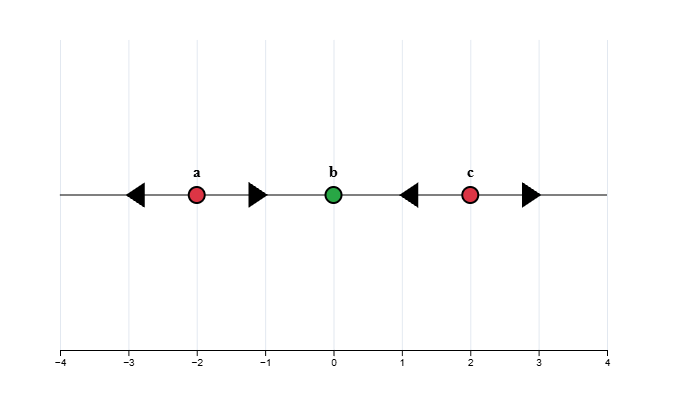
Consider the autonomous equation $y' = y^3 - 4y$. Find all equilibria, draw the phase line and classify each equilibrium, and determine the long-term behavior when $y(0) = 1$ and when $y(0) = -1$.

(a) Setting $y' = 0$:

\[y^3 - 4y = y(y-2)(y+2) = 0 \implies y = -2, 0, 2\]

(b) Testing $f(y) = y(y-2)(y+2)$:

For $y < -2$: $f(-3) = (-3)(-5)(-1) = -15 < 0$ (←)

For $-2 < y < 0$: $f(-1) = (-1)(-3)(1) = 3 > 0$ (→)

For $0 < y < 2$: $f(1) = (1)(-1)(3) = -3 < 0$ (←)

For $y > 2$: $f(3) = (3)(1)(5) = 15 > 0$ (→)

Phase line: arrows left, right, left, right around equilibria -2, 0, 2

$y = -2$: unstable. $y = 0$: stable. $y = 2$: unstable.

(c) With $y(0) = 1 \in (0, 2)$: arrows toward 0, so $\lim_{t\to\infty} y(t) = 0$.

(d) With $y(0) = -1 \in (-2, 0)$: arrows toward 0, so $\lim_{t\to\infty} y(t) = 0$.

\[\boxed{y=-2, 2 \text{ (unstable)}; \; y=0 \text{ (stable)}; \; \text{both limits} = 0}\]

13.

Consider the differential equation $(t^2 - t - 6)y' + ty = \cos t$. Find the largest interval of existence if $y(0) = 1$, if $y(5) = 0$, and determine whether the theorem applies if $y(-2) = 4$.

Factoring: $t^2 - t - 6 = (t-3)(t+2)$. Discontinuities at $t = -2, 3$.

Intervals of continuity: $(-\infty, -2), (-2, 3), (3, \infty)$.

(a) $t_0 = 0 \in (-2, 3)$: $\boxed{(-2, 3)}$

(b) $t_0 = 5 \in (3, \infty)$: $\boxed{(3, \infty)}$

(c) $t_0 = -2$ is a discontinuity. The theorem does not apply at a point of discontinuity.

\[\boxed{\text{No, the theorem does not apply at a discontinuity.}}\]

14.

Solve the initial value problem $(e^{t}\sin y + 3y) + (e^{t}\cos y + 3t - 2y)y' = 0$, $y(0) = \pi/2$.

We have $M = e^{t}\sin y + 3y$ and $N = e^{t}\cos y + 3t - 2y$. Checking exactness:

\[M_y = e^{t}\cos y + 3, \qquad N_t = e^{t}\cos y + 3\]

Since $M_y = N_t$, the equation is exact. Integrating $M$ with respect to $t$:

\[\int M\,dt = \int (e^{t}\sin y + 3y)\,dt = e^{t}\sin y + 3ty + h(y)\]
\[F(t,y) = e^{t}\sin y + 3ty + h(y)\]

Using $F_y = N$: $e^{t}\cos y + 3t + h'(y) = e^{t}\cos y + 3t - 2y$, so $h'(y) = -2y$, giving $h(y) = -y^2$.

\[F(t,y) = e^{t}\sin y + 3ty - y^2\]

With $y(0) = \dfrac{\pi}{2}$: $e^{0}\sin(\dfrac{\pi}{2}) + 0 - \dfrac{\pi^2}{4} = 1 - \dfrac{\pi^2}{4}$.

\[\boxed{e^{t}\sin y + 3ty - y^2 = 1 - \dfrac{\pi^2}{4}}\]

15.

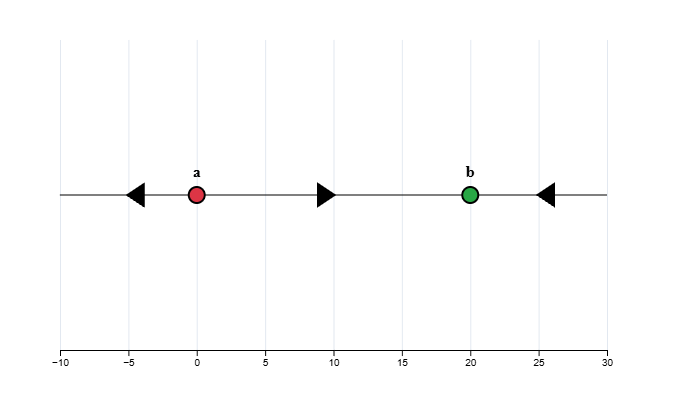
Consider the logistic equation $y' = 3y(1 - y/20)$. Find and classify all equilibria, solve the initial value problem with $y(0) = 5$ using partial fractions, and verify that $\lim_{t\to\infty} y(t) = 20$.

(a) Setting $3y(1-y/20) = 0$: equilibria at $y = 0$ and $y = 20$. Testing signs:

For $y < 0$: $f(-1) < 0$ (←)

For $0 < y < 20$: $f(10) > 0$ (→)

For $y > 20$: $f(25) < 0$ (←)

Phase line: arrow left below 0, arrow right between 0 and 20, arrow left above 20

$y = 0$ is unstable, $y = 20$ is stable.

(b) Separating variables:

\[\dfrac{20\,dy}{y(20-y)} = 3\,dt\]

Partial fractions: $\dfrac{20}{y(20-y)} = \dfrac{1}{y} + \dfrac{1}{20-y}$. Integrating:

\[\int \left(\dfrac{1}{y} + \dfrac{1}{20-y}\right)dy = \int 3\,dt \implies \ln\left|\dfrac{y}{20-y}\right| = 3t + C_1\]

Exponentiating: $\dfrac{y}{20-y} = Ce^{3t}$. With $y(0) = 5$: $\dfrac{5}{15} = C$, so $C = \dfrac{1}{3}$.

Solving for $y$: $3y = (20-y)e^{3t}$, so $y(3 + e^{3t}) = 20e^{3t}$.

\[y = \dfrac{20e^{3t}}{3 + e^{3t}} = \dfrac{20}{1 + 3e^{-3t}}\]

(c) As $t \to \infty$: $e^{-3t} \to 0$, so $y \to 20$. ✓

\[\boxed{y(t) = \dfrac{20e^{3t}}{3 + e^{3t}} = \dfrac{20}{1 + 3e^{-3t}}}\]

Additional Problems

16.

Consider the initial value problem $y' = -4t/y$, $y(0) = y_0$ where $y_0 \neq 0$. Solve the IVP, express the domain of the solution as a function of $y_0$, and determine for what values of $y_0$ the solution exists on the interval $[-1,1]$.

(a) Separating variables: $y\,dy = -4t\,dt$. Integrating:

\[\dfrac{y^2}{2} = -2t^2 + C \implies y^2 = y_0^2 - 4t^2\]
\[y = \pm\sqrt{y_0^2 - 4t^2}\]

(Choose the sign to match $y_0$.)

(b) For $y$ to be real: $y_0^2 - 4t^2 \geq 0$, i.e., $|t| \leq \dfrac{|y_0|}{2}$. Domain: $\left[-\dfrac{|y_0|}{2}, \dfrac{|y_0|}{2}\right]$.

(c) For the solution to exist on $[-1, 1]$: $\dfrac{|y_0|}{2} \geq 1$, so $|y_0| \geq 2$.

\[\boxed{y = \text{sgn}(y_0)\sqrt{y_0^2 - 4t^2}; \; |y_0| \geq 2}\]

17.

Determine whether each equation is exact, and if so, find the general solution: (a) $(2ty - 3) + (t^2 + 2)y' = 0$, (b) $(y\cos(ty) + 2t) + (t\cos(ty) - 1)y' = 0$, and (c) $(3t^2 + y) + (t - 2y)y' = 0$.

(a) $M = 2ty - 3$, $N = t^2 + 2$. We have $M_y = 2t$ and $N_t = 2t$. Exact.

Integrating $M$: $\int (2ty - 3)\,dt = t^2y - 3t + h(y)$.

\[F(t,y) = t^2y - 3t + h(y)\]

From $F_y = N$: $t^2 + h'(y) = t^2 + 2$, so $h'(y) = 2$, giving $h(y) = 2y$.

\[\boxed{t^2y - 3t + 2y = C}\]

(b) $M = y\cos(ty) + 2t$, $N = t\cos(ty) - 1$.

$M_y = \cos(ty) - ty\sin(ty)$ and $N_t = \cos(ty) - ty\sin(ty)$. Exact.

Integrating $N$ w.r.t. $y$: $\int (t\cos(ty) - 1)\,dy = \sin(ty) - y + g(t)$.

\[F(t,y) = \sin(ty) - y + g(t)\]

From $F_t = M$: $y\cos(ty) + g'(t) = y\cos(ty) + 2t$, so $g'(t) = 2t$, giving $g(t) = t^2$.

\[\boxed{\sin(ty) - y + t^2 = C}\]

(c) $M = 3t^2 + y$, $N = t - 2y$. We have $M_y = 1$ and $N_t = 1$. Exact.

Integrating $M$: $\int (3t^2 + y)\,dt = t^3 + ty + h(y)$.

\[F(t,y) = t^3 + ty + h(y)\]

From $F_y = N$: $t + h'(y) = t - 2y$, so $h'(y) = -2y$, giving $h(y) = -y^2$.

\[\boxed{t^3 + ty - y^2 = C}\]

18.

Consider the one-parameter family of autonomous equations $y' = y^2 - 4y + k$. For $k = 3$, find and classify all equilibria. Repeat for $k = 4$ and $k = 5$, describing the long-term behavior of solutions when $k = 5$.

Equilibria satisfy $y^2 - 4y + k = 0$, giving $y = 2 \pm \sqrt{4-k}$.

(a) $k=3$: $y = 2 \pm 1$, so equilibria at $y = 1$ and $y = 3$.

Testing $f(y) = (y-1)(y-3)$:

For $y < 1$: $f(0) = 3 > 0$ (→)

For $1 < y < 3$: $f(2) = -1 < 0$ (←)

For $y > 3$: $f(4) = 3 > 0$ (→)

Phase line: arrow right, left, right around 1 and 3

$y=1$ is unstable, $y=3$ is stable.

(b) $k=4$: $y = 2$ (double root). $f(y) = (y-2)^2 \geq 0$. Arrows (→) everywhere except at $y = 2$.

Phase line: arrows right everywhere, equilibrium at 2

$y = 2$ is semistable.

(c) $k=5$: $y = 2 \pm \sqrt{-1}$ gives complex roots. No real equilibria.

$f(y) = (y-2)^2 + 1 > 0$ for all real $y$. Since $y' > 0$ everywhere, all solutions increase without bound.

\[\boxed{k=3: \; y=1 \text{ (unstable)}, \; y=3 \text{ (stable)}}\]
\[\boxed{k=4: \; y=2 \text{ (semistable)}; \quad k=5: \text{ all } y(t) \to +\infty}\]

19.

Determine whether the Existence and Uniqueness Theorem guarantees a unique solution for each of the following initial value problems: (a) $y' = t^2 + y^2$, $y(0) = 1$; (b) $y' = |y|$, $y(0) = 0$; (c) $y' = \sqrt{|y|}$, $y(1) = 0$; and (d) $y' = y\ln y$, $y(0) = 1$.

(a) $f(t,y) = t^2 + y^2$ and $f_y = 2y$. Both are continuous everywhere. At $(0,1)$: continuous. Yes.

(b) $f(t,y) = |y|$. The partial derivative $f_y = \text{sgn}(y)$ is undefined at $y = 0$. Since the initial condition has $y_0 = 0$, the theorem does not apply. No.

(c) $f(t,y) = \sqrt{|y|}$. The partial derivative $f_y \to \infty$ as $y \to 0$. Since the initial condition has $y_0 = 0$, the theorem does not apply. No.

(d) $f(t,y) = y\ln y$ (defined for $y > 0$) and $f_y = \ln y + 1$. At $(0, 1)$: $f = 0$ and $f_y = 1$, both defined and continuous. Yes.

\[\boxed{\text{(a) Yes, (b) No, (c) No, (d) Yes}}\]

20.

Consider the differential equation $(2ty + t^2y^2) + (t^2 + \dfrac{2}{3}t^3y)y' = 0$. Verify that it is exact, find the general solution, and solve the initial value problem with $y(1) = 3$.

(a) We have $M = 2ty + t^2y^2$ and $N = t^2 + \dfrac{2}{3}t^3y$. Checking exactness:

\[M_y = 2t + 2t^2y, \qquad N_t = 2t + 2t^2y\]

Since $M_y = N_t$, the equation is exact. ✓

(b) Integrating $N$ with respect to $y$:

\[\int N\,dy = \int \left(t^2 + \dfrac{2}{3}t^3y\right)dy = t^2y + \dfrac{t^3y^2}{3} + g(t)\]
\[F(t,y) = t^2y + \dfrac{t^3y^2}{3} + g(t)\]

Using $F_t = M$: $2ty + t^2y^2 + g'(t) = 2ty + t^2y^2$, so $g'(t) = 0$.

\[F(t,y) = t^2y + \dfrac{t^3y^2}{3}\]

General solution: $t^2y + \dfrac{t^3y^2}{3} = C$.

(c) With $y(1) = 3$: $(1)(3) + \dfrac{1}{3}(1)(9) = 3 + 3 = 6$.

\[\boxed{t^2y + \dfrac{t^3y^2}{3} = C}\]
\[\boxed{t^2y + \dfrac{t^3y^2}{3} = 6}\]