Differential Equations · Spring 2026 • Sections 1.1–1.3, 2.2
Directions: Full worked solutions for Week in Review 1 (Differential Equations). Click Solution under any problem to reveal the worked answer. Use the Contents panel or the Prev / Up / Next buttons to move between sections, and Search to find terms on this page.
1.2 Solutions and Initial Value Problems
1.
Is $e^{2x}$ a solution to the differential equation $u'' - 4u' + 4u = 0$?
Let \( u(x) = e^{2x} \). Then the first derivative is \( u'(x) = 2e^{2x} \) and the second is \( u''(x) = 4e^{2x} \).
Substituting into the equation gives:
\( 4e^{2x} - 4(2e^{2x}) + 4(e^{2x}) = 4e^{2x} - 8e^{2x} + 4e^{2x} = 0 \).
The equation holds true for all \( x \), so yes, \( e^{2x} \) is a solution.
2.
Is $\sin(3x)$ a solution to the differential equation $h^{(4)}(x) - h''(x) = 8\sin(3x)$?
Let \( p(t) = \cos(2t) \). Then \( p'(t) = -2\sin(2t) \) and \( p''(t) = -4\cos(2t) \).
Substituting into the differential equation:
\( -4\cos(2t) + (-2\sin(2t)) + 4\cos(2t) = -2\sin(2t) \),
which is not equal to \( 2\sin(2t) \).
Although the initial condition \( p(0) = \cos(0) = 1 \) is satisfied, the function does not satisfy the differential equation itself. Therefore, \( \cos(2t) \) is not a solution to the IVP.
4.
Find the values of $r$ for which $e^{rt}$ is a solution to $w'' - 5w' + 6w = 0$.
Assume \( w(t) = e^{rt} \). Then \( w'(t) = r e^{rt} \) and \( w''(t) = r^2 e^{rt} \).
Substituting into the equation:
\( r^2 e^{rt} - 5 r e^{rt} + 6 e^{rt} = 0 \).
Dividing through by \( e^{rt} \) (which is never zero) gives the characteristic equation:
\( r^2 - 5r + 6 = 0 \).
Factoring yields \( (r-2)(r-3) = 0 \), so the roots are \( r = 2 \) and \( r = 3 \).
5.
Find the values of $k$ such that $\cos(kx)$ solves the differential equation $v + 9v'' = 0$.
Let \( v(x) = \cos(kx) \). The second derivative is \( v''(x) = -k^2 \cos(kx) \).
Substituting into the equation:
\( \cos(kx) + 9(-k^2 \cos(kx)) = (1 - 9k^2) \cos(kx) = 0 \).
For this to hold for all \( x \), we must have \( 1 - 9k^2 = 0 \), so \( k^2 = \dfrac{1}{9} \), and therefore \( k = \pm \dfrac{1}{3} \).
6.
Find the values of $m$ for which $y = t^m$ is a solution to the Euler equation
\[ t^2 y'' - 3ty' + 3y = 0. \]
Assume \( y(t) = t^m \) for \( t > 0 \). Then \( y'(t) = m t^{m-1} \) and \( y''(t) = m(m-1) t^{m-2} \).
(a) This is a PDE because it involves partial derivatives with respect to two independent variables, \( s \) and \( t \). The highest-order derivative is first order, so it is order 1.
(b) This is an ODE (only one independent variable, \( x \)). The highest derivative is second order, so the equation is of order 2.
(c) This is an ODE (only \( z \) is the independent variable). The highest derivative is third order, so the equation is of order 3.
(d) This is a PDE (partial derivatives with respect to \( x \) and \( y \)). The highest-order derivatives are second order, so it is order 2.
8.
For each of the following ODEs, determine if it is linear or nonlinear. If it is linear, determine if it is homogeneous or nonhomogeneous.
(a) Nonlinear — the term \( u'' u \) is a product of the function and its second derivative.
(b) Nonlinear — the term \( 1/h'(t) \) involves the reciprocal of a derivative.
(c) Linear and homogeneous — after moving all terms to one side we get \( P'''(x) + \sin(x) P'(x) - (x^2 + \cos(x)) P(x) = 0 \), which is linear with no forcing term.
(d) Nonlinear — the term \( x^3 w^2 \) is quadratic in \( w \).
(e) Linear and nonhomogeneous — the equation can be written as \( v^{(6)} + \sin(s) v''' = \cos(s) - s^2 \), which is linear in \( v \) and its derivatives, but the right-hand side is nonzero.
1.1 Direction Fields
9.
Sketch the slope field for the differential equation $u' = u^2 - 4u$. Draw some example solutions to the ODE. If the initial condition is $u(0) = c$, how does the long-time behavior of $u(t)$ depend on $c$?
Rewrite the equation as \( u' = u(u - 4) \). Equilibrium solutions occur where \( u' = 0 \), so \( u = 0 \) and \( u = 4 \).
The sign of \( u' \) determines the direction of the slopes:
• When \( u < 0 \), \( u' > 0 \) → solutions increase.
• When \( 0 < u < 4 \), \( u' < 0 \) → solutions decrease.
• When \( u > 4 \), \( u' > 0 \) → solutions increase.
Thus \( u = 0 \) is a stable equilibrium (solutions approach it from both sides within the interval), while \( u = 4 \) is unstable (solutions move away from it).
Long-time behavior as \( t \to \infty \):
• If \( c < 4 \) (including negative values), \( u(t) \to 0 \).
• If \( c = 4 \), \( u(t) = 4 \) for all time.
• If \( c > 4 \), \( u(t) \to +\infty \).
10.Direction Field Matching
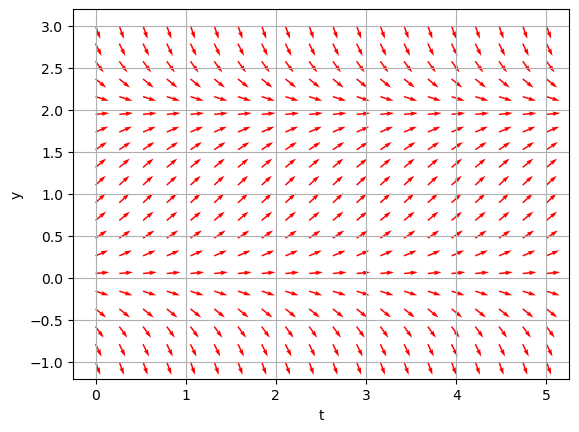
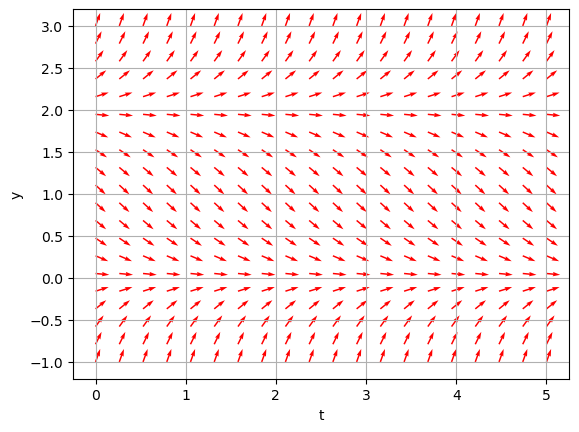
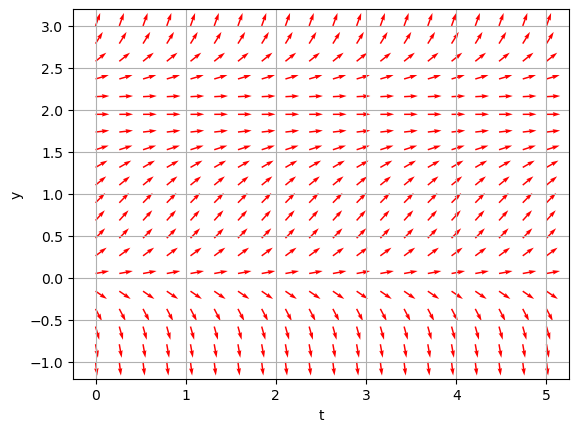
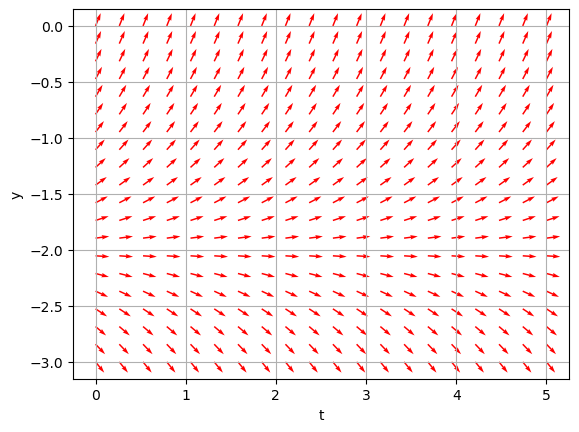
Part 1: Consider the following list of differential equations, some of which produced the direction fields shown in the figures below. Identify the differential equation that corresponds to each given direction field.
(a) $y' = y(y-2)^2$
(b) $y' = y(2-y)$
(c) $y' = y+2$
(d) $y' = -y(2-y)$
(e) $y' = -2-y$
Part 2: Use the direction fields below to determine the behavior of $y$ as $t\rightarrow \infty$. If this behavior depends on the initial value of $y$ at $t=0$, describe this dependency.
Figure (a)
Figure (b)
Figure (c)
Figure (d)
Figure 1: Direction fields for Question 10
Part 1 – Matching direction fields:
Figure (a) → (b) \( y' = y(2-y) \) (stable node at 2, unstable at 0).
Figure (b) → (d) \( y' = -y(2-y) = y(y-2) \) (stable at 0, unstable at 2).
Figure (c) → (a) \( y' = y(y-2)^2 \) (unstable at 0, semi-stable at 2).
Figure (d) → (c) \( y' = y + 2 \) (unstable equilibrium at -2).
Part 2 – Long-term behavior as \( t \to \infty \):
Figure (a): Solutions approach 2 from below and above if starting near it; go to \(-\infty\) if starting below 0.
Figure (b): Solutions approach 0 if starting below 2; diverge to \(+\infty\) if starting above 2.
Figure (c): Solutions go to \(+\infty\) if starting above 0; go to \(-\infty\) if starting below 0.
Figure (d): Solutions go to \(+\infty\) if starting above -2; go to \(-\infty\) if starting below -2.
2.2 Separable ODEs - Separation of Variables
11.
Determine if each of the following are separable or linear.
(a) $v'(t) = \dfrac{\sin(t)}{\cos(v)}$
(b) $\dfrac{dp}{ds} = \sin(ps)$
(c) $xw^3 \dfrac{dw}{dx} = 5$
(d) $u' = 3u + 7$
(e) $\dfrac{dh}{dt} = 6h - 2t$
(f) $t^2v - v' = 4$
(g) $q' = 3 + t + 3q + tq$
(a) Separable (can write as \( \cos(v) \, dv = \sin(t) \, dt \)); nonlinear.
(b) Neither clearly separable nor linear in standard form.
Integrate both sides:
\( e^{h} = 7x - x^2 + C \).
So \( h(x) = \ln(7x - x^2 + C) \).
Apply the initial condition \( h(3) = 2 \):
\( 2 = \ln(21 - 9 + C) \Rightarrow e^2 = 12 + C \Rightarrow C = e^2 - 12 \).
The solution is therefore:
\( h(x) = \ln(7x - x^2 + e^2 - 12) \).
The expression inside the logarithm must be positive:
\( 7x - x^2 + e^2 - 12 > 0 \).
Rearrange: \( -x^2 + 7x + (e^2 - 12) > 0 \).
This quadratic inequality holds between the two roots (approximately \( 0.7361 < x < 6.2639 \) ). Thus the solution is defined on that open interval.
15.Newton's Law of Cooling
A cup of coffee at temperature 95°C is placed in a room where the ambient temperature is 20°C. After 5 minutes, the temperature of the coffee is 70°C.
(a) Set up and solve the differential equation that models the temperature of the coffee as a function of time using Newton's Law of Cooling.
(b) What will be the temperature of the coffee after 10 minutes?
(c) How long will it take for the coffee to cool to 40°C?
(a) Model and solution
Let \( u(t) \) be the temperature of the coffee at time \( t \) (in minutes). By Newton's Law of Cooling, the rate of change is proportional to the difference between the coffee temperature and the room temperature:
\[ u' = -k (u - 20), \quad u(0) = 95. \]
Make the substitution \( y = u - 20 \). Then \( y' = u' \) and the equation becomes:
\[ y' = -k y, \quad y(0) = 95 - 20 = 75. \]
This is a standard separable equation of the form \( y' = a y \) with \( a = -k \). The general solution is:
\[ y(t) = C e^{a t} = C e^{-k t}. \]
Apply the initial condition:
\[ y(0) = C = 75 \quad \Rightarrow \quad y(t) = 75 e^{-k t}. \]
Back-substitute to obtain the solution for \( u \):
\[ u(t) = 20 + y(t) = 20 + 75 e^{-k t}. \]
Use the given data at \( t = 5 \): \( u(5) = 70 \)
\[ 70 = 20 + 75 e^{-5k} \quad \Rightarrow \quad 50 = 75 e^{-5k} \quad \Rightarrow \quad e^{-5k} = \dfrac{50}{75} = \dfrac{2}{3}. \]
Taking the natural log:
\[ -5k = \ln\left(\dfrac{2}{3}\right) \quad \Rightarrow \quad k = -\dfrac{1}{5} \ln\left(\dfrac{2}{3}\right) = \dfrac{1}{5} \ln\left(\dfrac{3}{2}\right). \]